
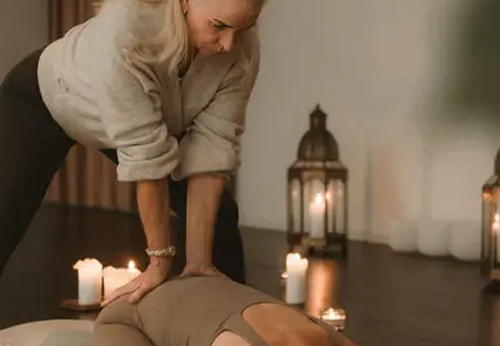
An interview with the fantastic Malin Lemchen Frimanzon, who works as a doula and runs @doulabymalin, doulabymalin.se
Malin Lemchen, 56 years old, doula with a husband, 2 children, and 4 grandchildren.
Background: Health and wellness, personal trainer, yoga teacher, nutritionist, masseuse, skin and spa therapist.
Let's start from the beginning: Who is Malin Lemchen Frimanzon?
I have always had a predilection for female power and pregnancy. I see pregnancy and childbirth as a form of wellness, so when I became a grandmother, the idea and longing to work with pregnant women arose, and I trained as a doula at Doulagruppen in Bromma. I work with my clients much like in the gym; mental training, the physiological body, and I try to use what is already present in many mothers' daily lives and training and help them apply it to childbirth, so they don't have to reinvent the wheel.
I base everything on "Föda utan rädsla" (Birth Without Fear) and Hypnobirth.
What does it mean to have a doula during pregnancy/childbirth?
A doula provides support during pregnancy, childbirth, and postpartum. This support is for both the mother and the father if they wish, so a doula does not replace the father but complements his support.
No one is more important than the father, and when I can relieve him, he can be there for her security and in love during the birth. The father can let go of his own worries and practical concerns.
During pregnancy, some mothers feel that the support from antenatal care is not enough and want more companionship, information, and support. They need answers to questions that alleviate anxiety, build self-confidence, feel vulnerable and held, and learn more about the pregnant body and what actually happens during childbirth. Many feel that their partner is not present and does not understand what pregnancy entails and is not interested in talking about pregnancy and childbirth. I try to work with the word "you" as in "You are pregnant!" to include him and relieve her.
When it comes to childbirth, there are various reasons for having a doula, such as if you have some trauma from a previous birth, sexual trauma, don't trust the healthcare system, have a bad partner, love to buy services, want to do everything for a positive experience and a good start as a family, independence, a husband who travels a lot and cannot be present, want to "manage" childbirth without pain relief, dare to have a breech birth, water birth, receive the baby, are afraid of arguing because things don't work well under stress, etc., all of which require extra support. The reasons are many and varied as to why someone wants a doula. One must be very open and non-judgmental.
As a doula, I can also follow up with the couple at home after birth to support with breastfeeding, postpartum, and provide relief in various ways.
I am also a support because it's comforting to know that someone will catch them on the other side in what they are experiencing then and there when they come home.
What is the difference between a doula and a midwife?
A midwife is responsible for the birth and, above all, has a medical responsibility. A doula works with support, a supportive function without medical responsibility.
The advantage of a doula is that she knows the couple and has the opportunity to adapt her work to the couple's needs, reflect on the couple, and thereby understand and plan more about what they want, require, and need. I have a longer lead-in time to provide support than a midwife who needs to form an opinion about the couple then and there, on the spot.
I often act as a spokesperson between the couple and the midwife.
What are your best tips for creating a calm and positive birthing environment?
My absolute best tip for the environment is preparation. All results lie in preparation. Make sure the partner/support person has full control over what the mother needs, how she wants support, and what she needs relief from. Then the mother can let go and feel held, focus, and work deep within where the answer to her calm lies. She can be with the baby. That she herself is prepared, has dealt with any fear or discomfort so she can give birth with full power, work on her breathing and relaxation. At that critical moment, it's too late. Work on preparation with an open mind that things can change.
- Darkness, music, and water are 3 ingredients that contribute to calm for most people.
- That the mother knows she has no social responsibility in the room. She can be a diva and a queen at the same time.
- A clear birth plan, with emphasis on clear.
- Presence of everyone involved regardless of role and position.
How do you help the partner feel involved and engaged?
I help the partner by bonding with him so that he feels secure. I explain that the partner is the most important person in the room and that his presence, interest, and engagement can be absolutely crucial for the mother's experience and the outcome. The partner is the path to oxytocin. This initially makes them a bit scared but also motivated. We go through "Föda utan rädsla" (Birth Without Fear), and then they have a role and understand how and in what way they can help. The partner needs tools, a role, and clarity to feel secure. They need to know that they are never in the way and that they should contribute to their own bonding.
Then we talk a bit about golf, powerlifting, football, or anything else they can relate to, and through that, they understand how to support and coach.
I look them in the eye and say that it is your shared responsibility to birth this child, to breastfeed this child. The mother physiologically, absolutely, but the responsibility for it going well and working is YOURS. They need to be seen, like the mother; some feel they've fallen behind, no one asks them about their fears. Some are jerks and need to be bitten in the leg, so I do that. Sounds harsh, but I do it with a twinkle in my eye... You get it!
What are the most common concerns you encounter?
The biggest concerns are losing control, tearing, feeling alone, worries about the baby, pooping, worry that the midwife won't be empathetic but rather patronizing and stressed, and breastfeeding.
What would you say is the best and most challenging aspect of your job?
The best thing is that I make an enormous difference for these couples. An unreasonable difference. You contribute and do good, and to see families go from confused and worried to secure and strong. I also relieve and reassure the midwife. Extremely grateful. The hardest part is probably the uncertainty of when the baby will arrive when on call. It's difficult to live a normal life if you have several births in a month. Always on call and always having backup for other things like yoga classes, dinners, and other commitments. I work full-time with this, and then it can get messy; if it's a hobby, it's probably different.
Last but not least, what is the most important lesson you would want all expectant parents to take with them?
The lesson is to prepare yourselves. Please, prepare yourselves thoroughly! It won't sort itself out on the spot. And take it easy during the latent phase. Prepare yourselves as if you're going to run 10 kilometers; sleep, eat, bond, replenish electrolytes, go through what you need to keep track of, forget about the contraction app.
Childbirth is not a medical event; it's something natural that the body is meant to handle, so believe in YOURSELVES, believe that you can, and be in LOVE!



Leave a comment
This site is protected by hCaptcha and the hCaptcha Privacy Policy and Terms of Service apply.